

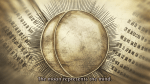
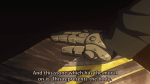
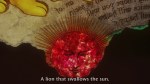
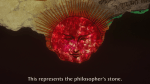
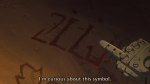


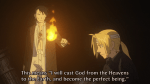
It’s entirely possible that I’m alone in this, but I also found these parts of the episode really interesting. I’m wondering how many of these symbols were actually used in alchemy. I also really loved the design of the two Gates enough that I had to go and Google some of the things written on them. Here are some images of the Gate that was behind Alphonse (click through for bigger versions):
The main words that I could make out were “corpus” and “spiritus” (in the second image on the left and right) and “anima” (at the top of the first image). A little Googling found me here explains goes into more detail on this passage and on a later passage, saying: The sun, as symbol of the light of consciousness, is identified with the masculine power here symbolized in the king, while the moon, the power of the tides of life both in the sea and in the womb, is the principle personified in the queen. Continuing with Jung…: ‘From all this it may be gathered that the queen stands for the body and the king for the spirit, but that both are unrelated without the soul, since this is the vinculum which holds them together. SO BASICALLY all of this complicated text corroborates what Ed says as he’s entering the Gate:
The quotes from Jung and Campbell also bring up the symbols mentioned at the top of this photoset, the sun and the moon, except that their meanings don’t match up. In FMA:B, the sun is the soul and the moon is the mind, but the quotes above have the sun as the mind/spirit (I belief this refers to the word spiritus, which I think can mean “thought” rather being directly translatable to the English “spirit,” but I can’t find a good source for that), the moon as the body (corpus), and no concrete symbol that I can find for the soul (anima). AND SINCE I HAVEN’T WRITTEN ENOUGH YET here’s something else entirely, a close-up of the Gate that Ed goes through at the end of the episode:
Most of this text is really difficult to read, even up this close, but you can clearly make out “Adonai,” a Hebrew word for God, and if you click that link you can see that the Hebrew text looks just like the symbol Ed is pointing out in the photoset above (although in FMA:B it’s upside-down, like Ed says). There’s also Malcuth, which is the bottom-most sephirot in the Kabbalah’s Tree of Life – and after I realized that, it only took a little bit more Googling to realize that the image on the Gate of Truth is a depiction of the Tree of Life by Robert Fludd:
Sorry for barging in without even reading all that (I will soon because interesting, but now don’t have the time.)
Overly long side note: The fandom spent a long time wondering where the image on Al’s Doors came from, apparently it’s from George Ripley’s work called Marrow of Alchemy, but for the longest time, no one was able to find a good picture on the Web. Eventually someone did:
But years before that, I managed to notice that more or less the same illustration is found in Samuel Norton’s work called Catholicon Physicorum:
(Don’t ask how I found that, it’s a long story). And further googling caused me to find a partial online version of some book called Dictionary of Alchemy, where another alchemical diagram from the same work was explained. (Link here! I hope it works…) The illustration being described is a bit different, it’s this one:
But if you feel like analyzing, it might still be helpful.
(…Sorry about this, I spent a while finding this stuff back in the day, apparently some of that enthusiasm remains.)
Ooh, nice! No need to apologize; this looks really interesting. That book you linked (the Dictionary of Alchemy that talks about the “Catholicon physicorum”) calls its diagram the “Tree of Stages and Processes.” Part of that book that stood out to me was this:
…in general the initial aim of the opus was to reduce metals to their Prime Matter in order to create the conditions for transmutation to occur. At an early stage separation takes place, and this is interpreted in the context of the idea of the divine Creation as set out in the Book of Genesis. The alchemical opus is a microcosm of the majestic process of God’s Creation, which involved the initial separation of the four elements. In all alchemical illustrations the myths of death and rebirth are repeated over and over again.
(“Opus” is Latin for “work” or “task” FYI.)
The book goes on to describe that Samuel Norton’s diagram portrays the process transmuting of antimony. It’s a bit difficult to understand, but one of the key parts of the process is the “separation of soul from body,” and the two are reunited later in the process (obviously this is pretty fitting for Al).
So, the Gate that Al is shown sitting next to is the Tree of Stages and Processes (an example of the alchemical process and “a microcosm of the majestic process of God’s Creation”), and the Gate that Ed is pulled through is the Tree of Life from Judaic Kabbalah (which is really complicated but as I understand it is a way of organizing the universe as well as a way of representing God, and I think it can also be used to describe God’s creation of the universe). Basically, to me it looks like Al’s Gate is the micro- level of creation (an example of creation that humans are capable of) and Ed’s Gate is the macro level of creation (life, the universe, and everything).


 Mashups and Exports