

zacharielaughingalonewithsalad:
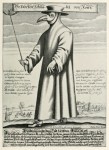
During the Bubonic Plague, doctors wore these bird-like masks to avoid becoming sick. They would fill the beaks with spices and rose petals, so they wouldn’t have to smell the rotting bodies.
A theory during the Bubonic Plague was that the plague was caused by evil spirits. To scare the spirits away, the masks were intentionally designed to be creepy.
Mission fucking accomplished
Okay so I love this but it doesn’t cover the half of why the design is awesome and actually borders on making sense.
It wasn’t just that they didn’t want to smell the infected and dead, they thought it was crucial to protecting themselves. They had no way of knowing about what actually caused the plague, and so one of the other theories was that the smell of the infected all by itself was evil and could transmit the plague. So not only would they fill their masks with aromatic herbs and flowers, they would also burn fires in public areas, so that the smell of the smoke would “clear the air”. This all related to the miasma theory of contagion, which was one of the major theories out there until the 19th century. And it makes sense, in a way. Plague victims smelled awful, and there’s a general correlation between horrible septic smells and getting horribly sick if you’re around what causes them for too long.
You can see now that we’ve got two different theories as to what caused the plague that were worked into the design. That’s because the whole thing was an attempt by the doctors to cover as many bases as they could think of, and we’re still not done.
The glass eyepieces. They were either darkened or red, not something you generally want to have to contend with when examining patients. But the plague might be spread by eye contact via the evil eye, so best to ward that off too.
The illustration shows a doctor holding a stick. This was an examination tool, that helped the doctors keep some distance between themselves and the infected. They already had gloves on, but the extra level of separation was apparently deemed necessary. You could even take a pulse with it. Or keep people the fuck away from you, which was apparently a documented use.
Finally, the robe. It’s not just to look fancy, the cloth was waxed, as were all of the rest of their clothes. What’s one of the properties of wax? Water-based fluids aren’t absorbed by it. This was the closest you could get to a sterile, fully protecting garment back then. Because at least one person along the line was smart enough to think “Gee, I’d really rather not have the stuff coming out of those weeping sores anywhere on my person”.
So between all of these there’s a real sense that a lot of real thought was put into making sure the doctors were protected, even if they couldn’t exactly be sure from what. They worked with what information they had. And frankly, it’s a great design given what was available! You limit exposure to aspirated liquids, limit exposure to contaminated liquids already present, you limit contact with the infected. You also don’t give fleas any really good place to hop onto. That’s actually useful.
Beyond that, there were contracts the doctors would sign before they even got near a patient. They were to be under quarantine themselves, they wouldn’t treat patients without a custodian monitoring them and helping when something had to be physically contacted, and they would not treat non-plague patients for the duration. There was an actual system in place by the time the plague doctors really became a thing to make sure they didn’t infect anyone either.
These guys were the product of the scientific process at work, and the scientific process made a bitchin’ proto-hazmat suit. And containment protocols!
reblogging for the sweet history lesson
Reblogging because of the History lesson and because the masks, the masks are cool
Tag Archives: this is really interesting
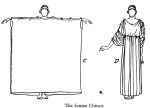
Marjorie & C. H. B.Quennell, Everyday Things in Archaic Greece (London: B. T. Batsford, 1931).
Wait, wait…. Is that seriously it? How their clothes go?
that genuinely is it
yeah hey whats up bout to put some fucking giant sheets on my body
lets bring back sheetwares
When you’re carding, spinning and weaving everything from scratch, using the big squares exactly as they come off the loom must seem like a fucking brilliant idea. 90% (or more) of pre-14th century clothing is made purely on squares (and sometimes triangles cut from squares).
How did they get the fabric so fine it draped like that? Was that something medieval europe forgot? Or do I just have a completely misguided image of historical clothing?
Medieval Europe also had incredibly fine weaves, though the ancient world tended to have them beat. Linen was found in Egypt woven with a fineness that we’re still trying to replicate, and there was a kind of cotton woven in India called ‘woven wind’ that was supposedly still translucent at eight layers, and wool shawls so fine that the entire thing could be drawn through a wedding ring.
The way they could get away with pinking and slashing doublets in the 16th century was partially because the fabrics were so tightly woven that you could simply cut a line on the bias and nothing would fray.
Modern fabric machining sucks ass in terms of giving us any kind of quality like the kind human beings produced prior to the Industrial Revolution.
*yells about textile history*
Reblogging because it’s fascinating.
The Celts made very fine clothing as well. They invented plaid after all, and the same weaves that have been found at the La Tene/Halstatt salt mines in Austria were also found as far away as western China in the tombs of the Tarim mummies.
Can we talk about 18th century and regency era muslin as well because that shit is gorgeous. It’s so fine it’s more transparent than silk chiffon and oh the tiny hems you can make with it!! I have an 18th century neckerchief and the hem is about 2mm wide. Not kidding, 2mm!!! Because it didn’t fray like our stuff does now. All we can produce nowadays is a rough, scratchy, bullshit excuse for muslin and it’s horrid.
I love this because we’ve gotten so blind to what makes ‘good’ fabric now – machine lace? horrible scratchy shit mostly made from poly. Actual lace is handmade, lasts for fucking EVER and looks stunning.
Regency gowns fucking rocked in terms of fabric quality – we use muslin as a ‘throw away’ before sewing the real fabric, back then it WAS a real fabric and it was so finely made you wouldn’t even think it was the same stuff.
Hand hemming is still the best way to finish off anything, but harder than hell because of the shitty weave of modern fabrics.
Satin? Silks?!
Pah. Yes, fabric is cheaper, more affordable and varied than before, but it is an area where QUALITY was sacrificed for QUANTITY.
(I don’t want to seem like I’m shitting on how great we have it now for clothes and martials or anything, because YAY!! but also, I’d love to get my mits on a bolt of real Muslin)
archaeologists recently found some Bronze Age fabric woven on site and preserved in marsh in England. it’s fine to die for. they were exporting it and trading into Asia.
I’m not into fashion, but I love reading about the history and evolution of it.
I stumbled across this post the other day, and even though it’s really neat, I noticed a couple errors in the math and the image is way too small to read. So I completely remade it because I’m a giant nerd (and the OP’s blog has been deleted so I have no way of getting in touch with them). I mean, normally I wouldn’t care enough to do something like this, but bloodlines are very important in Tolkienverse which makes me, in turn, very interested in the exact breakdowns.
Also because—ever since I read Silm—I’ve wanted to know exactly how ‘elven’ Elrond actually is because I knew for sure it wasn’t literally half. It turns out Elrond is 56.25% elf, 37.5% human, and 6.25% maiar. The more you know.
Everything movies taught me about archery is wrong. This is a complete mind-blower. 8D
If you are even remotely interested in archery or medieval combat, check this out, it’s just great!
OMFG EVERYONE PLEASE DROP WHAT YOU’RE DOING AND WATCH IT RIGHT NOW O_O
HOLY HELL
Not only is this fascinating, there are a lot of images from art history here. It just goes to show that what you can learn from the past isn’t limited to facts you can know, but things you can do.
My favorite part?
He learned this doing research for LARPs (Live Action Role Playing):
Lars Andersen originally started using bow and arrow to fight in pretend battles during Larps (live action role play) events, where he played a soldier in a medieval-inspired army. While Larps can be about anything – the Danish/Polish Harry Potter inspired larp College of Wizardry (cowlarp.com) recently got world-wide media attention and there wasn’t a rubber sword in sight there – many Larps take place in fantasy worlds inspired by J.R.R. Tolkien’s The Lord of the Rings. And it was at one of these Larps, that Lars started to learn to shoot fast while moving.
In 2012, Lars Andersen released his video, “Reinventing the fastest forgotten archery”, where he showed how he had learned to shoot from old archery manuscripts. Using these old, forgotten techniques, Lars demonstrated how he was now the fastest archer on the planet, and after its release, the video got 3 million hits on YouTube in two days.
Since the 2012 video was released, Lars has studied and practiced, and he is now able to fire three arrows in 0.6 seconds – a truly stunning feat making him much faster than the legendary fictional archer Legolas (played by Orlando Bloom in the Lord of the Rings movies).
The time benchmark he was trying to achieve, according to the video, was the expectation of the speed at which “Saracen“ archers were expected to shoot. In fact, most of the source material as far as I can see isn’t European.
A lot of the techniques described are also used in Mongolian Archery, which requires being able to shoot from horseback, and is traditionally practiced by men and women. You can see a video here.


